


Antique Glass Marks Identification
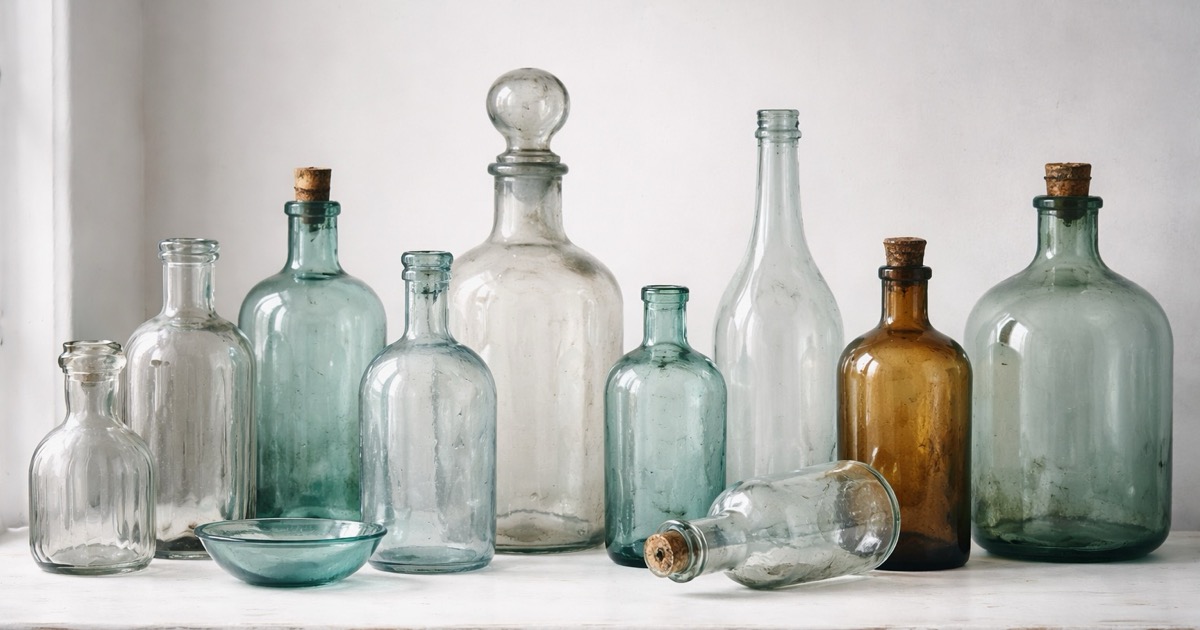
Antique glass marks identification starts on the base: tilt the piece to raking light and look for an acid-etched signature, a molded logo, a pontil scar, or a stamped number ground into the foot. Most collectible glass carries its evidence there rather than on the side you display. A signature or registry number points you to a maker and often a date range, while the absence of a mark is normal and shifts the work to the glass itself: color, weight, seam lines, and finishing.
The goal here is not certainty from one photo. It is to help you find the mark if there is one, read it correctly, and know what the glass is telling you when there is no mark at all. Unsigned pieces make up a large share of antique glass, so the strongest identifications usually combine any mark with the physical clues below.
Quick identification checklist
- Turn the piece over first: the base holds the pontil scar, seam terminations, and nearly all maker’s marks.
- Use raking light to reveal shallow acid-etched signatures and worn molded logos.
- Record any mark exactly as written, including partial letters, numerals, and symbols.
- Check for a pontil scar or ground pontil, which signals older, mouth-blown production.
- Note mold seams and where they end, since seam height helps date machine-made glass.
- Judge color, weight, ring, and wear before trusting any single mark.
Where glass marks hide
Glass makers put their marks where the eye rarely goes. The base carries the great majority of signatures, whether acid-etched into the center, molded into the foot, or applied as a paper label that has usually long since fallen off. On stemware, check the underside of the foot and sometimes the stem itself. On pressed and molded pieces, the mark is often molded in relief or intaglio and can be nearly invisible until you catch it in angled light.
Two kinds of marks matter most. A maker’s mark is a signature, logo, or monogram that names the company or artist. A registry or design mark is a code, most famously the British “Rd” or diamond registration mark, that records when a design was registered rather than who made it. British registered-design marks changed format over the decades, so the exact layout tells you an era; museum and reference databases document these systems in detail (V&A glass collection). Record everything you see, even fragments, because a single legible numeral can be the key that unlocks the rest.
Reading maker’s marks and signatures
Once you find a mark, transcribe it literally before you interpret it. A “W” inside a keystone, an anchor over an “H,” an underlined script signature, an entwined monogram: each belongs to a specific maker or narrow group of makers, and small differences separate them. Signed art glass from studios and named designers usually carries an acid-etched or engraved signature, sometimes with a number. Factory pressed glass more often carries a molded logo or none at all.
Numbers deserve their own attention. Some are pattern or mold numbers that identify a line rather than a date. Others, especially on machine-made bottles and utility glass, are date and plant codes; established marks databases explain how to read maker logos and the numerals flanking them (Glass Bottle Marks). Never assume a number is a year. Record it exactly, note its position, and let a maker-specific reference interpret it. When a mark is worn to a partial shape, photograph it in several lighting angles rather than guessing at the missing strokes.
Common glass mark types by era
Different production methods left different signatures on the glass, and the type of mark itself narrows the age band before you even read it. Use the table as a first sort, then confirm with the specific logo or number.
| Mark or feature | Typical era | What it tells you |
|---|---|---|
| Rough or ground pontil scar on base | Pre-1860s, mouth-blown | Hand-finished, older production; higher likelihood of age |
| British diamond “Rd” registration mark | 1842–1883 | Design registration date, decoded from the mark’s layout |
| “Rd No.” followed by digits | 1884 onward (UK) | Registered design number; maps to a registration year |
| Acid-etched script signature | Late 1800s onward, art/studio glass | Named maker or designer; verify the exact signature form |
| Molded logo in relief on the base | 20th-century pressed/factory glass | Company mark; cross-check against a marks database |
| “Made in [country]” molded or stamped | Generally 1890s onward | Import/export marking, useful as a rough earliest date |
Treat era ranges as guides, not proof. Reproductions can copy older marks, and a genuine mark can appear on a later reissue, so the physical glass has to support whatever the mark suggests.
When there is no mark
Most antique glass is unsigned, so learn to read the object itself. Start with the base: a pontil scar (a rough or ground-off circle where the glassblower’s rod was attached) indicates mouth-blown, generally older work, while a smooth base with a valve or suction scar points to machine production. Mold seams tell a parallel story. On machine-made glass the seams run up and over the lip; on earlier mouth-blown and applied-lip pieces they stop short of the rim.
Then weigh and listen. Older lead-rich glass (often sold as crystal) feels heavier for its size and rings with a sustained tone when tapped gently, though ring alone is not decisive. Look at color: some period glass carries a faint gray, straw, or lilac cast from the era’s raw materials, and uranium glass fluoresces green under UV light. Finally, read wear honestly. Genuine base wear is a network of fine, randomly oriented scratches concentrated where the piece meets a surface; a uniform ring of coarse, same-direction scratches is a warning sign of faked aging. For a deeper walkthrough of these physical tests, see how to tell if glass is antique, and for lead-glass tableware specifically, how to tell if cut glass is antique.
Watch-outs and common mistakes
- Assuming an unmarked piece is not antique; most antique glass was never signed at all.
- Reading a mold or pattern number as a date without a maker-specific key.
- Trusting a molded mark alone, since molds and marks have been copied and reissued.
- Confusing a smooth, polished pontil (a finishing step) with a machine-made base valve scar.
- Scrubbing or polishing the base before photographing it, which erases diagnostic wear.
Photo tips that improve identification
- Photograph the base straight on in raking light so etched and molded marks stand out.
- Take a second base shot from a low angle to throw shallow marks into relief.
- Shoot the full profile and the rim so seam height and lip finish are visible.
- Capture any signature or number tight and in focus, with a note of exactly where it sits.
Common questions
Where are marks usually found on antique glass?
Almost always on the base. Look for an acid-etched signature in the center, a molded logo in the foot, a stamped number, or the ghost of a paper label. On stemware, also check the underside of the foot and occasionally the stem. Raking light across the base reveals shallow etched or molded marks that are invisible head-on.
Is antique glass without any mark still valuable?
Yes. A large share of antique glass was never signed, so an unmarked piece is completely normal and can still be valuable. Value then rests on the glass itself: color, weight, quality of the blowing or cutting, pattern, condition, and any pontil or seam evidence of age. An honest description of the physical traits usually serves you better than forcing a maker name.
What is the diamond-shaped mark on old glass?
That is a British design registration mark, used from 1842 to 1883, which records the date a design was registered with the patent office rather than the maker. Its layout of letters and numbers around a central diamond decodes to a specific registration date. From 1884 onward the diamond was replaced by an “Rd No.” followed by a serial number that also maps to a year.
Related guides
- How to Tell If Glass Is Antique
- How to Tell If Cut Glass Is Antique
- Depression Glass Identification
- Fenton Glass Identification
- Carnival Glass Identification
When to use the Antique Identifier app
The app is most useful after you have taken one clear base photo in raking light plus a full profile shot. It can help narrow the likely type, era, and maker from a mark or the glass’s characteristics, which makes your follow-up research faster. If the result points to something signed, rare, or high value, treat that as a prompt to verify against a marks database or a professional, rather than a final answer.
Topics