


Red Wing Stoneware Identification
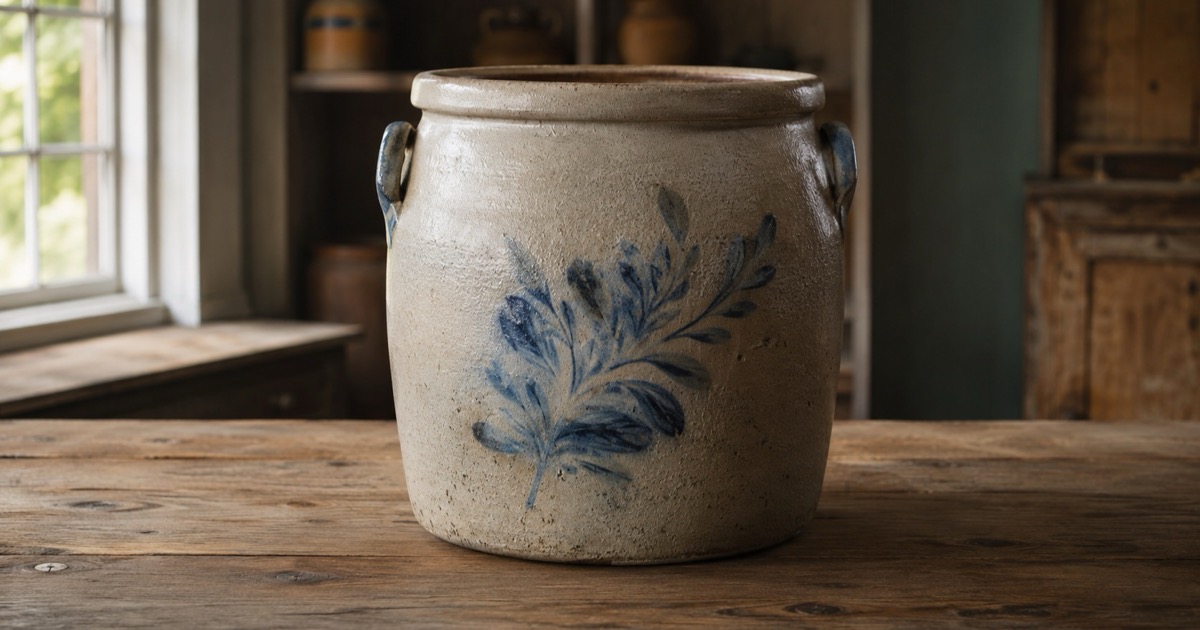
Red Wing stoneware is among the most collected American utilitarian pottery, and for good reason: the company produced an enormous range of crocks, jugs, churns, and jars over several decades, leaving behind a paper trail of marks and construction changes that experienced collectors use as a rough dating framework. Understanding those clues makes Red Wing stoneware identification far more systematic than it first appears.
Red Wing stoneware is utilitarian American pottery — crocks, jugs, and churns — made in Red Wing, Minnesota, from the 1870s through the mid-twentieth century. The two most diagnostic tells are the company wording in the bottom stamp and the red wing graphic on the side. Start by reading the base stamp; the exact company name places the piece in its era.
That long run produced several distinct company eras, each with its own marking conventions and glaze approaches.
Quick identification checklist
- Read the bottom stamp carefully: the exact wording tells you the company era
- Examine the red wing graphic on the side — wing size and style shifted across periods and is used as a rough dating aid
- Check the glaze: salt-glazed gray stoneware with cobalt decoration is earlier; smooth white or cream glaze with printed marks came later
- Look for a capacity number impressed or stamped on the side or shoulder (e.g., a “4” indicating four gallons)
- Inspect the base for additional impressed numbers, potter’s marks, or origin stamps
- Confirm the weight and wall thickness — genuine utilitarian pieces are heavy, thick-walled, and built to work
Company name eras and what they mean
Red Wing stoneware was produced under several company names, and the name used in a mark is one of the most reliable dating anchors available.
The earliest production came from the Red Wing Stoneware Company, which operated under that name during the later nineteenth century. Pieces from this period carry marks bearing that full name, often stamped in blue or impressed.
The company later reorganized and absorbed other local potteries, operating for a period as Union Stoneware with an oval stamp design. This transition era produced pieces that collectors use as a bridge between the earliest and middle-period production.
The most commonly found mark across a wide range of pieces references Red Wing Union Stoneware — a name used during the early decades of the twentieth century. Later still, the company simplified to the “Red Wing” name used into the mid-century period when they shifted focus toward art pottery and dinnerware lines.
The wording of the bottom stamp is a practical dating tool: “Red Wing Union Stoneware Co.” places a piece in a different era than “Red Wing” alone.
The red wing graphic and wing size as a dating aid
Many Red Wing pieces carry the familiar red wing graphic, typically applied as a red slip or stenciled mark on the side of the piece rather than on the base. Collectors and dealers have long used wing size as a rough, general guide to dating: larger wings are generally associated with earlier production within the Union Stoneware era, while smaller wings became more common as production continued. This is a broad tendency, not a precise rule, and it works best when considered alongside the base stamp and other features rather than in isolation.
Salt-glazed vs. white-glazed production
The glaze on a piece tells you a great deal about when it was made. Earlier Red Wing stoneware is characteristically salt-glazed — the surface has a slightly mottled, orange-peel texture, and the body is a gray-tan stoneware clay. These pieces often feature hand-painted or slip-trailed cobalt blue decoration: leaves, flowers, target circles, and numerals applied by pottery decorators. Each decoration is individual, which is part of what makes earlier pieces particularly appealing to collectors.
Later production shifted to a smooth white or off-white zinc (Bristol-type) glaze, often with dark Albany slip lining the interior, with printed or stenciled marks replacing hand decoration. This later production is abundant, widely found at estate sales, and generally less sought-after than the earlier salt-glazed work — though exceptional examples exist in both periods.
Construction details like rim shape, handle style, and base treatment help fill in the picture when the glaze alone is ambiguous — the transition between types was not instantaneous.
Capacity numbers and bottom marks
Most Red Wing utilitarian stoneware was made to hold a specific volume — one gallon, two gallons, four gallons, and so on — and that capacity is almost always marked somewhere on the piece. On earlier pieces it may appear as an impressed numeral or a cobalt-painted number on the shoulder or side. On later pieces it is often part of the stamped mark.
The base can carry additional information: impressed mold numbers, capacity marks, and the company stamp, which overlap in ways that take practice to read. The base stamp is the primary dating resource.
Reproduction minis and fantasy advertising pieces
Two categories require extra caution. Small miniature crocks marked “Red Wing” were produced as promotional items, and modern reproductions are extremely common. Genuine early miniatures are scarce; most small pieces encountered today are later production or outright fakes. Check clay color at the unglazed foot ring and glaze texture against known examples.
Fantasy advertising pieces — crocks and jugs marked with merchant or store names — were popular with collectors, and that popularity produced fakes. A piece with an unusual advertising mark should be examined carefully; the stoneware body, glaze type, and stamp style must all be consistent with the claimed era.
Condition and value framing
Condition matters significantly with Red Wing stoneware. Cracks, even hairlines, reduce collector value substantially. Chips on the rim or base affect both appearance and price. Heavy staining from use — particularly dark interior staining in crocks used for food storage — is common and accepted, but extreme discoloration or damage to the decorated surface reduces value.
Earlier salt-glazed pieces with intact cobalt decoration in good condition represent the top of the market. Complete sets, unusual capacities, and rare decorative motifs command premiums. The vast middle — standard white-glazed crocks from the Union Stoneware period — is plentiful, and clean examples in common sizes sell at modest prices.
Watch-outs and common mistakes
- Wing size is a rough guide, not a precise date code — use it alongside the base stamp, not instead of it
- Many pieces described as “Red Wing” at sales are actually from other Minnesota potteries that used similar forms and glazes
- Reproduction miniature crocks are made to look old; check the clay body color at the unglazed foot ring
- An advertising mark alone does not make a piece rare — verify that the stoneware itself is consistent with the period the advertising implies
- Glaze crazing (fine surface cracks in the glaze) is normal aging and different from structural cracks — learn to distinguish them
Photo tips that improve identification
- Photograph the base flat-on to capture the full stamp text and any impressed marks clearly
- Photograph the side in good directional light to show the red wing graphic and any cobalt decoration without washing out contrast
- If the piece has a chip or worn area at the base, photograph it to show the clay body color — gray-tan clay vs. whiter clay is a useful supporting cue
- Photograph both sides if decoration is present on more than one face
Common questions
What do the numbers on a Red Wing crock mean?
The large numeral on the side or shoulder is a capacity mark — a “4” means the crock holds four gallons. On earlier salt-glazed pieces the number is often impressed or painted in cobalt; on later white-glazed pieces it is usually part of the stamped or stenciled marking. Impressed numbers on the base are typically mold numbers rather than capacities.
How can you tell a reproduction Red Wing crock?
Check the clay body color at the unglazed foot ring against known examples, and confirm that the glaze type, stamp style, and stoneware body are all consistent with the era the mark claims. Miniature crocks marked “Red Wing” deserve the most suspicion, since genuine early promotional miniatures are scarce and modern copies are extremely common. Unusual advertising marks should be examined with the same skepticism.
Is Red Wing stoneware still valuable?
The market splits sharply by era and condition. Earlier salt-glazed pieces with intact hand-applied cobalt decoration in good condition sit at the top, along with unusual capacities and rare motifs. Standard white-glazed crocks from the Union Stoneware period are plentiful and sell at modest prices, and any crack — even a hairline — reduces collector value substantially.
Related guides
- Antique Stoneware Crock Identification Marks
- Studio Pottery Marks Identification
- Antique Pottery Marks
When to use the Antique Identifier app
Photograph the full piece, a straight-on base shot showing the stamp, and a clear shot of the side wing graphic and any decoration or capacity marks. The app can identify the company era and mark type quickly. For pieces with unusual advertising marks or atypical decoration that might suggest rarity, use the app result as a starting point and compare against documented reference examples before drawing conclusions about value.
Topics