


Weller Pottery Marks: How to Identify and Date Weller
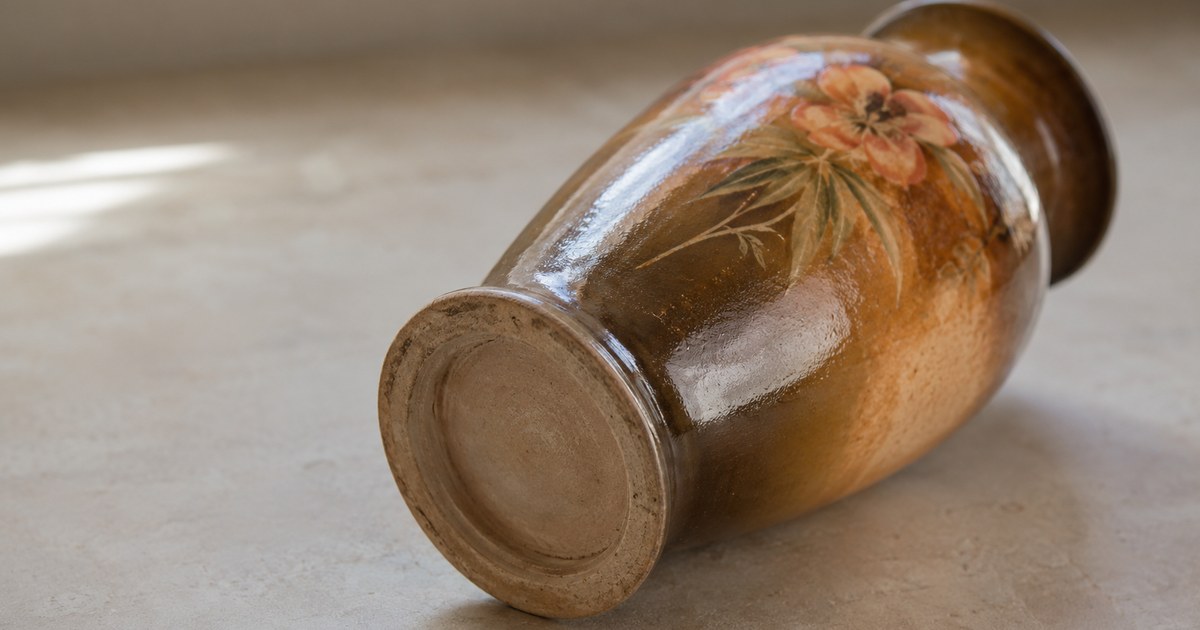
Most guides to Weller pottery marks hand you a tidy timeline of stamps and imply that reading the base settles the question. In practice, the first thing an experienced dealer notices about Weller is how much of it carries no mark at all. Samuel A. Weller founded the pottery in Fultonham, Ohio in 1872, it grew into one of the largest American art potteries of its era, and it operated until 1948. Across those decades the company used incised marks, seals, die stamps, ink stamps, paper labels, foil labels, and in-mold script, applied inconsistently, and researchers openly describe the Weller trademark record as untidy, attributed in part to the sheer number of artists and potters the firm employed.
Weller pottery marks follow a rough sequence: a half-circle line-name seal from about 1896, a double-circle form around 1910, a block-letter die-stamped WELLER to about 1925, a full-kiln ink stamp in the mid-1920s, a half-kiln stamp in the late 1920s, and raised in-mold “Weller Pottery” script from about 1933 until closure in 1948.
Quick identification checklist
- Look at the whole base first, not just the center. Weller marks sit anywhere on the underside, and remnants of a paper or foil label (a ring of dried adhesive, a lighter patch of glaze, a torn paper corner) count as evidence even when the label itself is gone.
- Decide which family the mark belongs to: incised or hand-written, impressed seal, die stamp, ink stamp, or raised in-mold lettering. The family narrows the era before the exact wording does.
- Read the line name if one is present. Early seals put the line name above the maker name, so “Louwelsa” or “Dickens Ware” is often doing more dating work than “Weller” itself.
- Check whether the mark type is plausible for the body it sits on. A mark that belongs to one era on a form or glaze that belongs to another is a reason to slow down.
- Assess the glaze and the modeling. For unmarked pieces this is the whole game: line, glaze character, and mold detail carry the identification.
- Feel the foot. Period Weller shows kiln-furniture contact, glaze pooling, and a soft, used quality to the unglazed ring that later copies rarely reproduce convincingly.
Start with the case the mark charts skip: no mark at all
A large share of surviving Weller left the factory either unmarked or carrying only a paper or foil label, and paper labels do not survive a century of dusting, washing, and moving. If your base is blank, that is normal for the category and not evidence against Weller. It just means the identification has to run through the object rather than the underside.
The working path for a blank base is line recognition. Weller sold distinct decorative lines, each with a consistent vocabulary of shape, glaze, and surface treatment, and those lines are far more numerous in the wild than legible marks are. Start by describing what you have in neutral terms: matte or gloss, hand-painted or molded relief, high-gloss brown ground with slip-painted flowers, iridescent metallic luster, naturalistic tree-bark modeling. Then compare that description against illustrated line references and auction archives, which show hundreds of documented examples per line. Shape number, rim profile, handle attachment, and the way the glaze breaks over raised detail are all usable comparison points.
Named lines are also date anchors in their own right. Louwelsa, the first major art line, runs roughly 1896 to 1924. Sicard, the iridescent luster ware, is a narrow window of about 1902 to 1907. Dickens Ware sits at roughly 1897 to 1905. Recognizing the line therefore brackets the piece even when nothing on the base does, and in the Sicard case it brackets it tightly.
The mark sequence, era by era
The earliest marks are incised or hand-written into the wet clay, which is why they wander in size and legibility. From about 1896 to the end of the 1900s decade, the standard was a half-circle seal with the line name arched across the top and “Weller” straight below it. Around 1910 the standard logo shifted to a double-circle form, with the pattern name running around the top of the circle and “Weller” at the bottom.
A block-letter die-stamped WELLER was in use from the late 1900s to about 1925, and it appears in two size variants, so a small block stamp and a large one are not different companies. The mid-1920s brought the full-kiln ink stamp, a pictorial mark showing a beehive kiln, and the late 1920s brought a half-kiln version of the same idea. Across the 1920s and 1930s the factory also leaned heavily on circular paper labels and black or silver foil labels, which is the direct reason so many pieces from those years read as unmarked today.
From about 1933 until the pottery closed, the mark you meet most often is a raised in-mold script reading “Weller Pottery,” molded into the piece rather than applied after the fact. Because it is part of the mold, it is the most durable of the marks and the one you will meet most often on later ware.
The cross-check most pages never teach
A mark by itself does not carry an attribution. What carries an attribution is agreement between the mark, the form, the glaze, and the foot.
Run the check in that order. If the base shows raised in-mold script, ask whether the piece looks like something the factory was making in the 1930s and 1940s. If the base shows an early half-circle seal with a line name, ask whether the body actually presents as that line: right glaze family, right decorative technique, right vocabulary of shapes. When the mark points to one decade and the object points to another, the mark is the part to doubt, because a mark is easy to imitate and a period glaze surface is not.
This matters most for the in-mold script, which is precisely what later reproductions copy. Raised lettering can be reproduced in a new mold as easily as any other raised detail, so “it says Weller Pottery in the mold” is the beginning of the inquiry rather than the end of it. Weigh the piece against a documented example of the same form: the modeling on a copy is usually softer, the glaze thinner or more even, and the foot too clean.
Watch-outs and common mistakes
- Treating a blank base as a verdict. Unmarked Weller is ordinary. So is unmarked ware from a dozen other Ohio potteries, which is why the line evidence has to be positive rather than merely “no mark, so probably Weller.”
- Reading the line name as a maker. “Louwelsa” is a Weller line, not a separate company, and the same logic applies to the other line names in early seals.
- Assuming one mark chart is authoritative. Published Weller timelines disagree with each other on details and rarely admit it. Treat any single date you read as approximate.
- Confusing Weller with its Zanesville-area neighbors. Several large potteries worked in the same region with overlapping glaze fashions, so brown-ground slip-decorated ware is a regional style rather than a maker signature.
- Letting a mark override the object. The most common way people talk themselves into a wrong attribution is finding the mark they hoped for and stopping there.
Photo tips
- Shoot the entire base square-on in soft, even daylight, close enough that the mark fills a good share of the frame, and take a second frame at a low angle so raised or impressed lettering casts a shadow and becomes readable.
- Photograph any label remnant or adhesive ring rather than cleaning it off, since a label ghost is real evidence about how the piece was originally marked.
- Take a full profile of the piece against a plain background so the silhouette, handle placement, and rim profile can be compared to documented forms.
- Add one close shot of the glaze where it breaks over raised detail or pools at the foot, in good light and from close range, because glaze behavior is what identifies unmarked pieces.
Common questions
How do I identify Weller pottery with no markings?
Work from the object instead of the base. Identify the decorative line by glaze character, modeling, and form, then compare against illustrated references and sold-auction archives for that line. Look for a paper-label ghost on the foot as supporting evidence. Unmarked and label-only pieces were common, so a blank base is normal rather than disqualifying.
What years do the different Weller marks cover?
Roughly: incised and hand-written earliest, half-circle line seal about 1896 to the close of that decade, double-circle around 1910, block-letter WELLER die stamp from the late 1900s to about 1925, full-kiln ink stamp mid-1920s, half-kiln late 1920s, and raised in-mold “Weller Pottery” script from about 1933 to the 1948 closure.
Is a raised “Weller Pottery” script mark proof the piece is old?
No. Raised in-mold lettering is reproduced easily because it is molded rather than applied, and it is the mark later copies most often imitate. Use it as one piece of evidence and confirm that the form, glaze quality, modeling crispness, and foot wear all agree with a genuine period example before treating the attribution as settled.
Related guides
- Roseville Pottery Marks Identification
- McCoy Pottery Marks Identification
- Hull Pottery Marks Identification
- Rookwood Pottery Marks Identification
When to use the Antique Identifier app
Weller is a good example of a category where a photo-based first pass saves real time. Shoot the base, the full profile, and one glaze close-up, and the app can suggest which mark family and which decorative line your piece resembles, which is exactly the narrowing step that is hard to do from a cold start. That is especially useful on unmarked pieces, where the question is not “what does the stamp say” but “which line does this glaze and shape belong to.” Treat the result as a lead to verify against auction archives and line references rather than as a finished attribution.
Topics